
Quick Answer
Existing tooling can be used only when the required dimensions, lid interface, bottom construction, edge treatment, corner radius, and other structural details are compatible with it.
Some changes - such as adjusting the height of certain non-drawn tins, converting a removable lid to a hinged version, adding embossing, or adding a window - may be possible by modifying or adding only selected process tooling. This is usually less expensive than replacing the complete tooling set, but every case still requires an engineering review.
A new tooling set, or a major group of new tools, is usually required when the length, width, diameter, basic shape, corner radius, lid interface, bottom construction, or opening mechanism changes.
The most useful first step is to send the required dimensions, product use, lid preference, reference photos, and target quantity to the manufacturer for a tooling compatibility review.
Terminology note: In everyday sourcing discussions, buyers often use the word "mold." For tinplate manufacturing, "tooling," "dies," and "forming tools" are usually more technically accurate. This guide uses tooling as the general term.
What Does "Existing Tin Box Tooling" Mean?
Existing tooling means production tools that the factory already owns and can make available for an appropriate project. It does not necessarily mean that finished tins are already in stock.
Factories commonly maintain tooling for standard shapes such as:
- Round tins
- Rectangular tins
- Square tins
- Oval tins
- Heart-shaped tins
- Other frequently requested formats
Some distinctive or customer-specific shapes may be restricted to the original customer and may not be available for other projects. Availability therefore depends on both technical compatibility and any applicable exclusivity arrangement.
Using existing tooling also requires more than selecting a similar-looking outline. The required tin must match the relevant production interfaces, including its dimensions, lid type, body construction, bottom structure, edge treatment, and corner radius.
Two tins that look nearly identical in a catalog may still require different tools.
Why One Tin Box Requires Multiple Tools
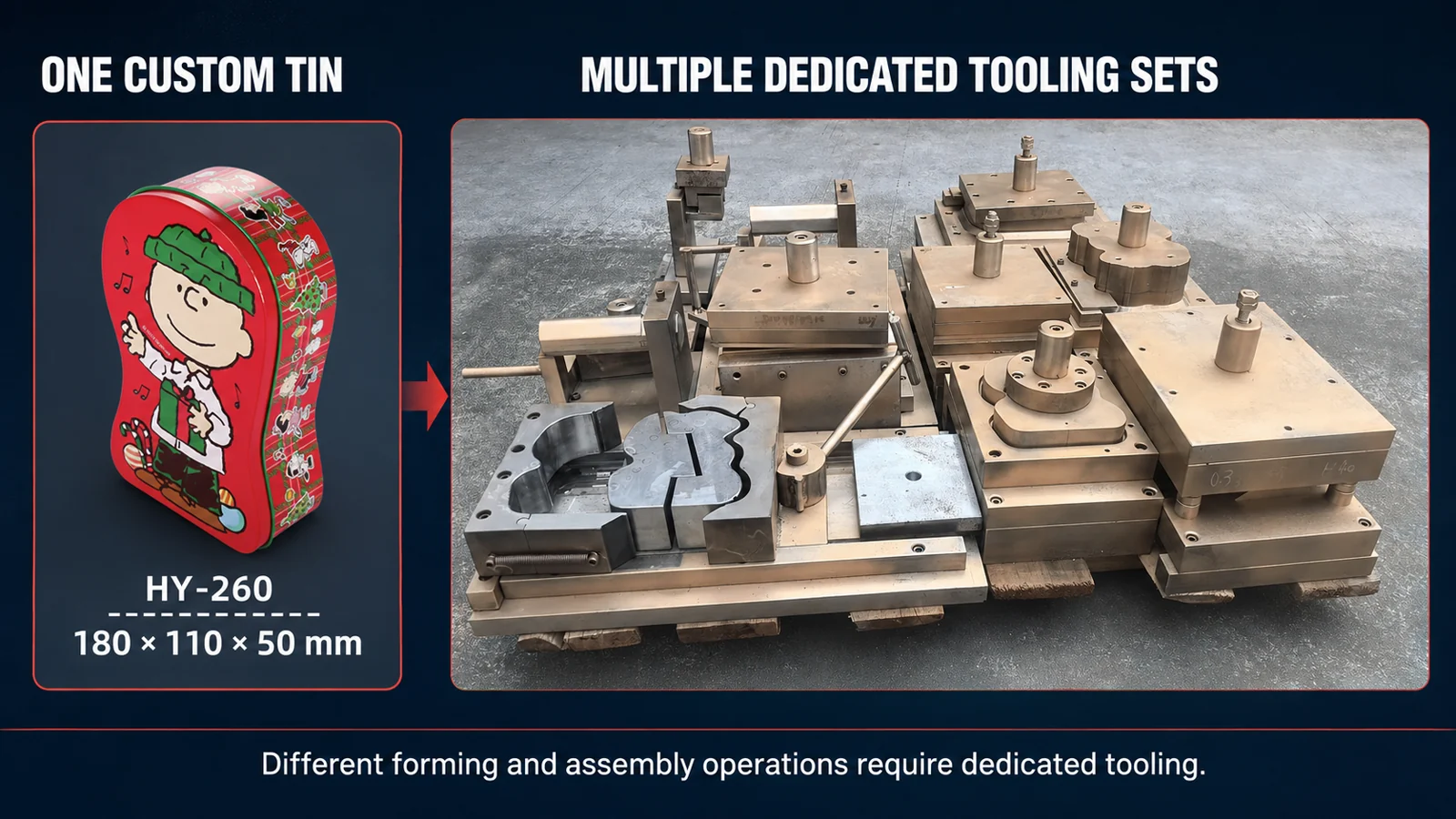
A complete tin box normally consists of a lid, a body, and a bottom. Each part can pass through several forming operations before final assembly.
A tooling set may include:
- Lid blanking and forming dies
- Bottom blanking and forming dies
- Body-forming tools
- Curling, wiring, or edge-forming tools
- Seaming or locking tools
- Flanging tools
- Embossing or debossing dies
- Window-cutting tools
- Assembly-related fixtures or gauges
Even one component can require several process tools. A lid, for example, may need separate operations for blanking, drawing or forming, edge curling, embossing, and fitting.
This is why the phrase "one mold for one tin" can be misleading. A single finished design may depend on a coordinated family of tools.
Three Different Tooling Situations
For practical project planning, tooling decisions should be divided into three categories.
| Situation | What it means | Typical cost impact |
|---|---|---|
| Reuse the complete existing tooling set | The proposed tin fully matches the existing dimensions and structural interfaces | Lowest tooling cost |
| Modify or add selected process tooling | Major interfaces remain compatible, but one or more operations need a new or modified tool | Lower than replacing the complete set, subject to review |
| Manufacture a new tooling set | Core dimensions, shape, construction, or interfaces are incompatible | Highest tooling investment and longest development time |
This distinction is important because "no full new tooling set" does not always mean "no tooling cost." A project may reuse most existing tools while still requiring one or more new dies.
Changes That May Be Possible Without a Full New Tooling Set
The following changes can sometimes be handled by keeping the compatible tools and adding or modifying only the tools required for the changed feature.
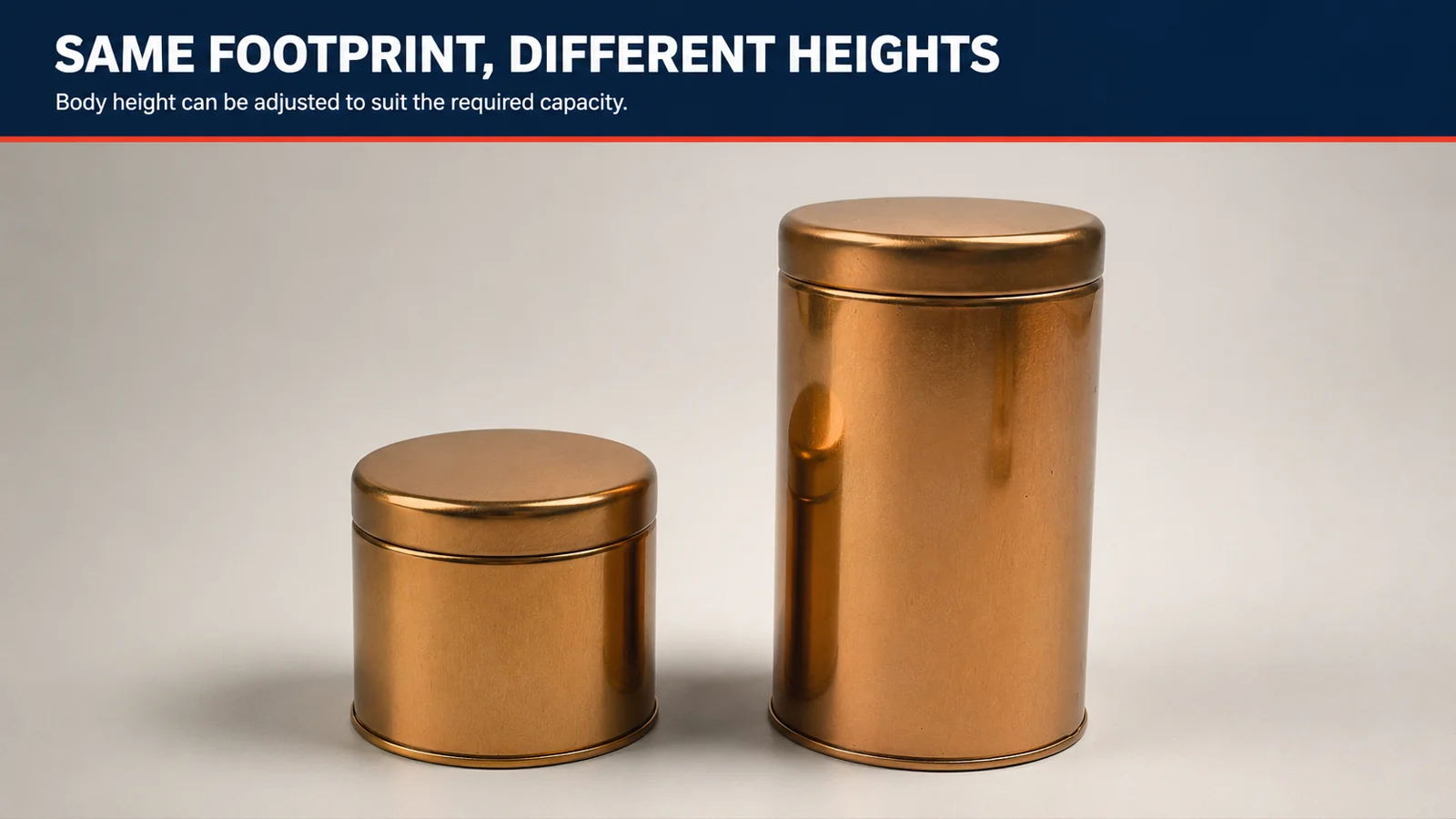
1. Changing the Height While Keeping the Same Footprint
For many non-drawn tins, the body height can be changed while the diameter - or the length and width - remains the same and the lid and bottom interfaces are unchanged.
For a conventional round tin with the same diameter, a new body-forming tool for the required height may be enough. The existing lid and bottom tools may still be usable.
The possible height range depends on:
- Tin diameter or footprint
- Body construction
- Tinplate thickness and temper
- Lid and bottom assembly method
- Forming equipment
- Required stability and appearance
For some suitable projects, heights may range approximately from 20 mm to 350 mm, but this is not a universal design range. Very short bodies may not leave enough material or working space to assemble the body and bottom reliably.
Important exception: one-piece drawn tins
A one-piece drawn body is formed from a single piece of tinplate. Its height is established by the drawing operation and its dedicated tooling. It cannot normally be changed in the same way as the height of a three-piece or assembled-body tin.
If an extremely shallow tin is required, a drawn construction may be more practical, but dedicated drawing tooling may be necessary.
2. Converting a Removable Lid to a Hinged Lid
A standard removable lid may sometimes be converted to a hinged version without replacing every tool. The existing main lid, body, and bottom dimensions may remain usable, while hinge-related components, assembly operations, or local forming tools are added.
This is not automatic. The lid-body fit, hinge position, opening clearance, and assembly method must be checked.
3. Changing a Flat Lid to a Raised Lid
A raised panel can sometimes be introduced by adding or modifying the lid-forming tool while keeping compatible blank dimensions and edge interfaces.
The required panel depth, corner transitions, artwork position, and material behavior must be reviewed before confirming reuse of the remaining lid tools.
4. Adding Embossing or Debossing
Embossing or debossing generally requires a matched embossing die. If the basic lid or body structure remains unchanged, it may be possible to add this feature without replacing the entire tooling set.
The embossing depth, artwork detail, location, surrounding flat area, and printed registration tolerance affect feasibility.
5. Adding a Transparent Window
A window may sometimes be added by introducing a cutting tool and the required film-installation process while retaining the main structural tooling.
The window position, border width, lid strength, film material, food-contact requirements, and adhesive or mechanical retention method all require review.
These examples are not exhaustive. Other partial modifications may be possible, but they should be assessed against the actual existing tooling rather than assumed from appearance alone.
Changes That Usually Require New Tooling
The following changes normally affect core geometry or production interfaces and therefore require new tooling for the affected components. In some cases, most of the tooling set must be replaced.
1. Changing Length, Width, or Diameter
A change in length, width, or diameter usually requires new tooling, even when the change is only 2-3 mm.
Stamping and forming tools are made to fixed dimensions. A small dimensional change can alter the blank size, wall position, lid fit, bottom fit, corner geometry, and assembly relationship.
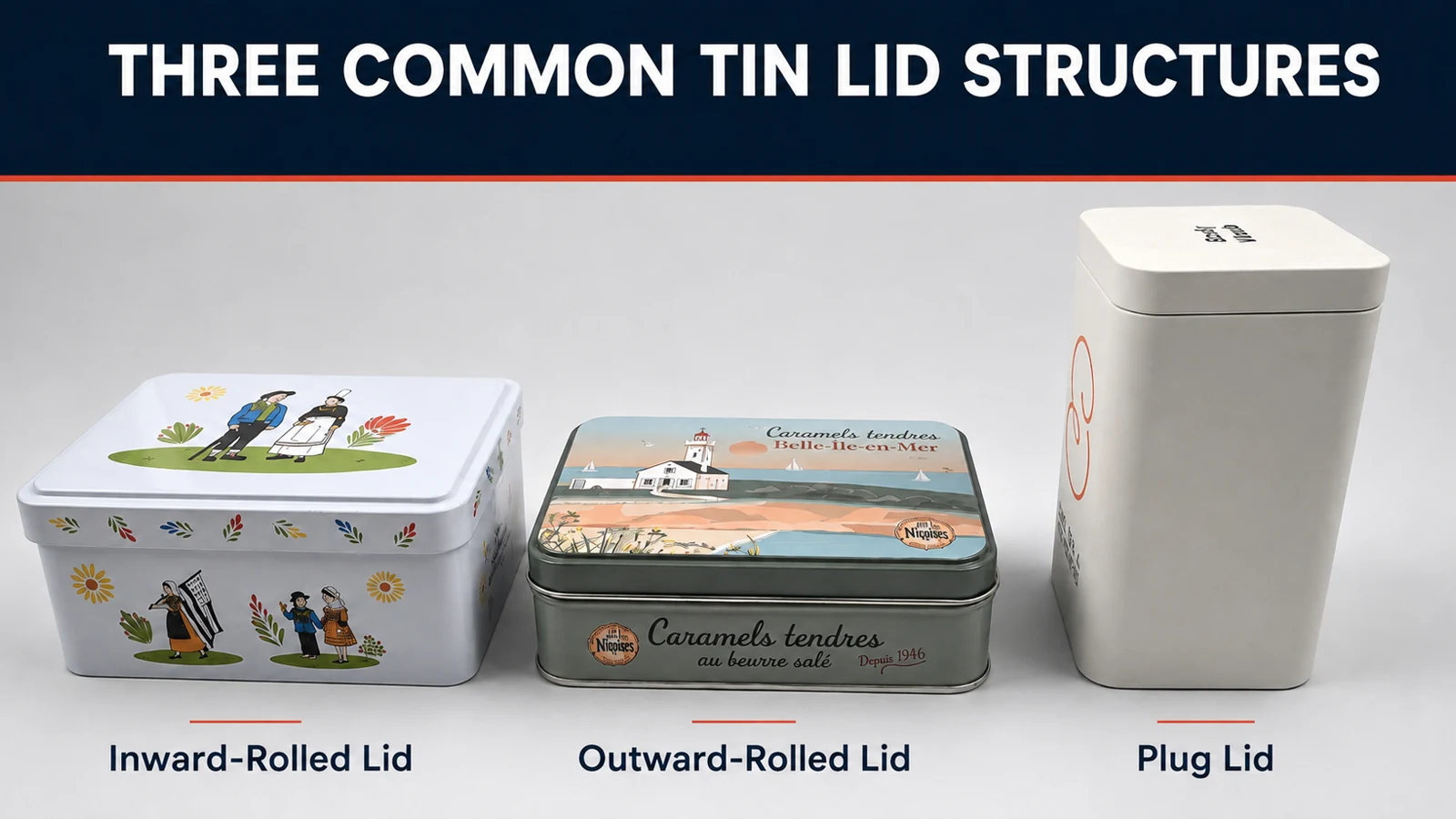
2. Changing the Rolled-Edge Direction
Changing from an outward-rolled edge to an inward-rolled edge - or the reverse - changes the edge-forming process and structural interface. New edge-forming and related component tooling is normally required.
3. Changing the Lid Structure
Changing to a different lid construction, such as a plug lid, normally requires new tooling for the affected lid and interface.
In a special case, if the body opening and the bottom structure remain fully compatible, only the lid-related tooling may need to be replaced. The body and bottom tools may still be reusable.
4. Changing the Bottom Construction
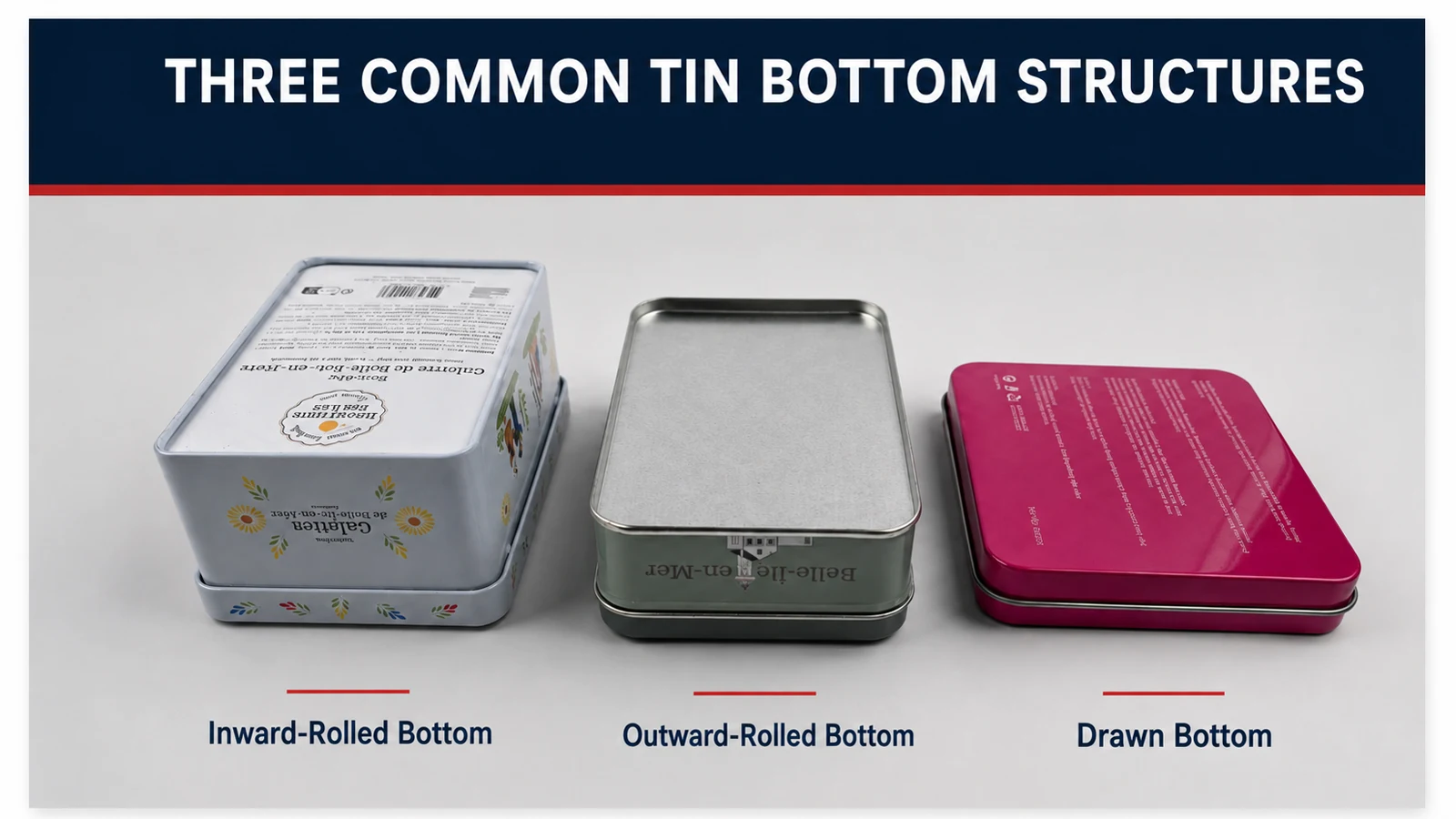
Rolled-in bottoms, seamed or locked bottoms, and drawn bottoms use different forming and assembly principles. Moving from one construction to another normally requires new bottom and interface tooling.
5. Changing to a Special Shape
Moving from a standard round, square, or rectangular format to an irregular or highly distinctive shape normally requires dedicated tooling.
The tooling must control the new outline, corners, wall transitions, lid fit, and bottom fit throughout multiple operations.
6. Changing the Corner Radius
The corner radius is part of the fixed geometry of rectangular and square forming tools. Changing it affects the lid, body, and bottom relationship and normally requires new tooling for the affected components.
7. Adding a Latch, Lock, Clasp, or Special Opening Mechanism
Special opening and closing features may require new local forming tools, component tooling, assembly fixtures, or a broader redesign. Their feasibility also depends on material strength and the available assembly area.
Again, these are common examples rather than a complete list. A drawing or physical sample is the best basis for a reliable tooling assessment.
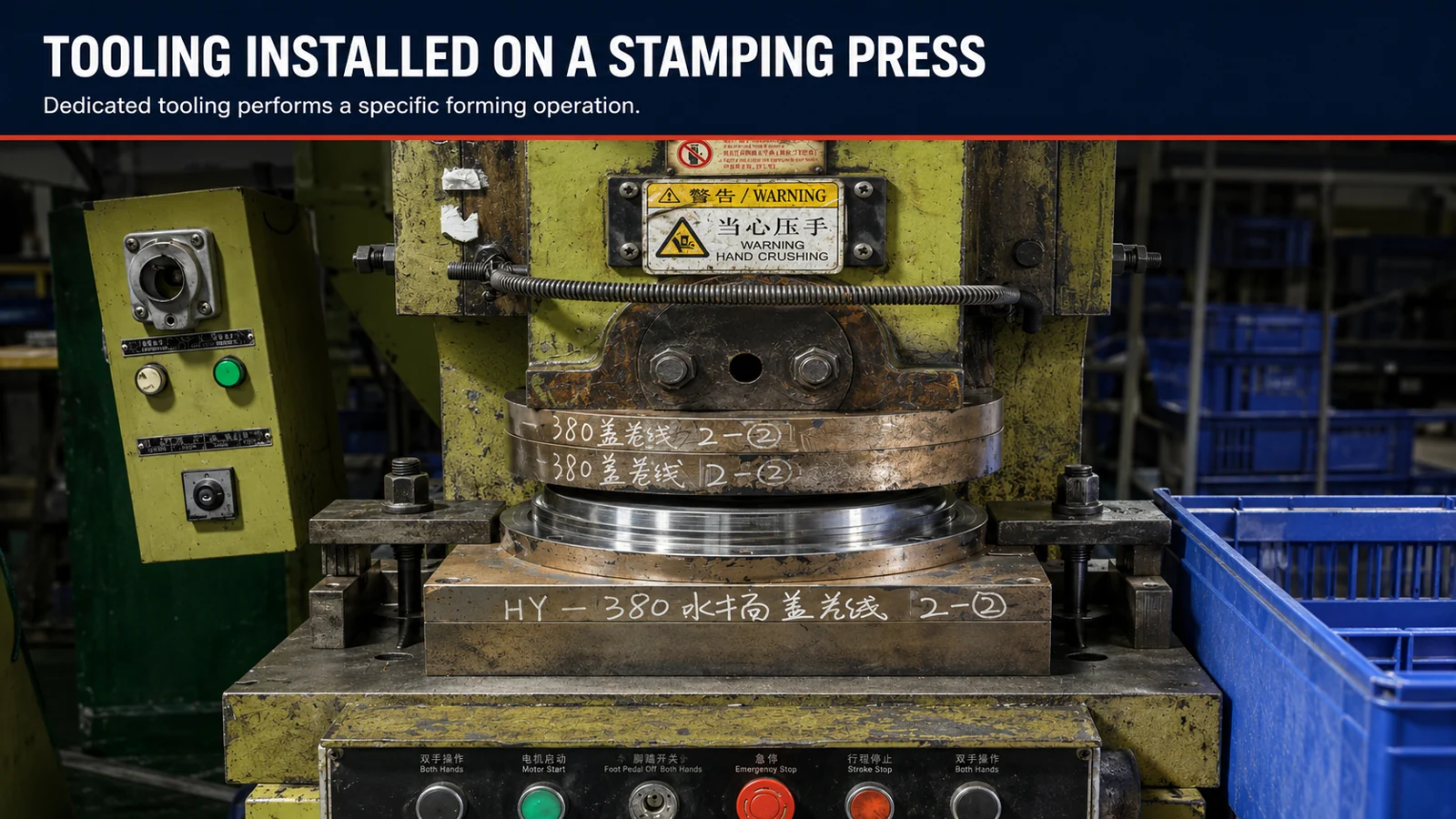
Tooling in Production
Tooling must be installed, aligned, tested, and adjusted on the appropriate stamping or forming equipment. The production result depends not only on the tool itself, but also on machine capacity, setup accuracy, material condition, and process control.
What Determines Tin Box Tooling Cost?
Tooling cost varies substantially and cannot be estimated responsibly from the outside dimensions alone.
The main factors include:
- Product size
- Structural complexity
- Number of forming and assembly operations
- Tool material and construction
- Accuracy and surface requirements
- Trial work and adjustment required
A simple component tool and a complete tooling family for a complex custom shape are very different projects. For this reason, HYTINPACK does not publish a single generic tooling price range. A drawing, reference sample, or detailed specification is required for quotation.
Tooling is normally charged as a one-time project cost rather than on every repeat order. Production costs, printing costs, and any later tooling changes remain separate. For a broader view of quantity planning, see our MOQ planning guide.
Tooling Ownership, Storage, and Maintenance
When the customer pays the agreed tooling charge, the tooling belongs to the customer in principle and is stored separately for that customer's production.
If the tooling cost is later refunded, credited, or offset against a qualifying large order - or if the factory funds the tooling - the ownership arrangement may be different. The final ownership and use rights should therefore be confirmed in the written quotation or project agreement.
Free storage period
HYTINPACK provides free storage of customer-owned tooling for at least five years. The five-year period is calculated from the completion date of the most recent production order made with that tooling.
If longer storage is required, an extension can be discussed separately. HYTINPACK will contact the customer before making a material change to the agreed storage arrangement.
Tool life
Under suitable production conditions, properly maintained tooling can often support more than two million production cycles. Actual service life depends on tool design, tool material, product structure, tinplate specification, production load, maintenance, and acceptable wear limits.
This figure should therefore be treated as a practical capability reference, not an unconditional lifetime guarantee.
Maintenance responsibility
Normal maintenance and minor repairs resulting from routine production use are generally handled by the factory.
Major rebuilding or replacement caused by customer-requested design changes, prolonged inactivity, service-life exhaustion, abnormal damage, or damage that cannot be economically repaired should be evaluated and agreed separately.
From New Tooling to an Approved Production Sample
New tooling is not transferred directly from machining to mass production. It normally passes through the following sequence:
- Tool trial
- Dimensional inspection
- Structural and fit adjustment
- Tooling sample production
- Customer sample approval
- Mass-production preparation
For a conventional new tooling project, the normal development period is approximately one month, including tooling sample preparation. More complex structures may require a separately agreed schedule.
Drawings, Artwork, and Pre-Tooling Confirmation
Before tooling manufacture begins, HYTINPACK provides a tooling or structural drawing for customer confirmation.
If the customer is uncertain about the structure, proportions, capacity, or handling, a paid 3D prototype can be prepared before committing to production tooling. A prototype can reduce the risk of discovering a basic design problem after the metal tooling has been completed.
While the tooling is being manufactured, an artwork dieline can be supplied so the customer can prepare the design and arrange printing approval in parallel.
When the tooling is ready, a printed tooling sample may be produced during the trial stage using the intended production printing specification. This allows the customer to evaluate both the structure and the printed appearance. If final artwork is not available, an unprinted tinplate sample can normally be made for structural confirmation.
What Can Be Changed After the Tooling Sample Is Approved?
After the customer approves the tooling sample, the main dimensions and structure are considered confirmed. Length, width, diameter, shape, corner radius, lid interface, and bottom construction generally cannot be changed without additional tooling work.
Height may still be adjustable in some non-drawn constructions, subject to engineering review. However, if the approved height must later be changed because the original customer specification was unsuitable, the additional tooling modification, trial, and sampling costs are normally the customer's responsibility.
This is why capacity, product fit, proportions, stacking, shipping use, and opening experience should be reviewed before final tooling approval.
Information to Provide for a Tooling Review
To determine whether existing tooling can be reused, partially modified, or replaced, provide as much of the following information as possible:
- Required length, width, diameter, and height
- Product to be packed
- Required internal capacity or product fit
- Preferred lid and bottom structures
- Reference photos or an existing physical sample
- Required corner radius or special shape
- Embossing, window, hinge, latch, or other functional features
- Target order quantity
- Destination market and any relevant packaging requirements
- Required project schedule
If exact specifications are not yet available, HYTINPACK can begin with a reference image and the intended product, then identify the dimensions that must be confirmed. Project-specific quality requirements should also be identified before the structure is finalized.
Practical Recommendation
Use existing tooling when the available dimensions and structures genuinely meet the packaging requirement. It is usually the fastest and most economical route.
Consider partial tooling changes when the main structure remains compatible and only a specific feature - such as height, hinge assembly, embossing, or a window - needs to change.
Invest in new tooling when the product requires a distinctive size, shape, interface, or opening experience that existing tooling cannot provide reliably.
The correct decision should be based on the finished product requirement, not simply on minimizing the initial tooling charge. A structurally unsuitable tin can create fit, appearance, assembly, and repeat-production problems that cost more than the tooling saved. For related manufacturing context, review our manufacturing process and custom tin packaging pages.
PROJECT REVIEW
Request a Tooling Compatibility Review
Send HYTINPACK your target dimensions, product use, lid preference, quantity, and reference images. Our production team will review whether the project can use an existing tooling set, requires only selected new process tools, or needs a new custom tooling set.
Request a Tooling ReviewContent Review
Written by the HYTINPACK Editorial Team
Technically reviewed by the HYTINPACK Production Team
Dongguan Huaiyang Metal Manufacture Co., Ltd.
This guide provides general manufacturing guidance. Final tooling feasibility, cost, ownership terms, storage arrangements, lead time, and service life must be confirmed for the specific project.
