
Quick Answer
Food-contact suitability depends on the complete packaging system, the food type, the contact conditions, and the destination-market requirements.
A material report or a general statement about tinplate does not automatically certify every finished tin box. Buyers should confirm the intended food, direct or indirect contact, internal coating, expected contact time and temperature, destination market, required tests, and agreed inspection criteria before production.
1. What Does “Food-Grade Tin Packaging” Mean?
“Food-grade tin packaging” does not refer only to the metal sheet. Food-contact safety involves the complete material system, including the tinplate, internal protective coating, printing ink, gloss or matte varnish, gold-colored or transparent coating, and any assembly materials used in the finished package.
External printing inks normally do not directly contact the food. If printing or a decorative coating is required on an internal food-contact surface, that application must be reviewed separately.
Food-contact suitability also does not mean that a tin is automatically airtight, liquid-tight, or sterile. Conventional general-line tins are mechanically formed rather than welded as hermetic cans. For many projects, the food should first be packed in an independent inner bag, sealed pouch, paper tray, liner, or other suitable primary package.
Tea, coffee, biscuits, chocolate, confectionery, powders, and similar products can be evaluated for tin packaging. Foods with high oil content, high acidity, high moisture, elevated filling temperatures, or long direct-contact periods require additional review of the coating system and testing requirements. No single tin construction should be treated as suitable for every food.
2. Materials Related to Food-Contact Safety
| Material or record | Role in the packaging system | Points to confirm |
|---|---|---|
| Tinplate | Forms the lid, body, bottom, and structural components. | Thickness, temper, surface condition, tin coating information, supplier, and batch. |
| Internal protective coating | Provides a barrier between the metal surface and the packed product. | Food type, direct or indirect contact, contact time, temperature, and destination market. |
| Printing ink | Creates graphics, brand colors, text, and decoration. | Print position and whether any printed surface may contact food. |
| Gloss varnish | Protects external printing and provides a glossy surface. | Coverage, adhesion, finish, and intended use. |
| Matte varnish | Protects printing while providing a lower-gloss appearance. | Coverage, rub resistance, appearance, and project specification. |
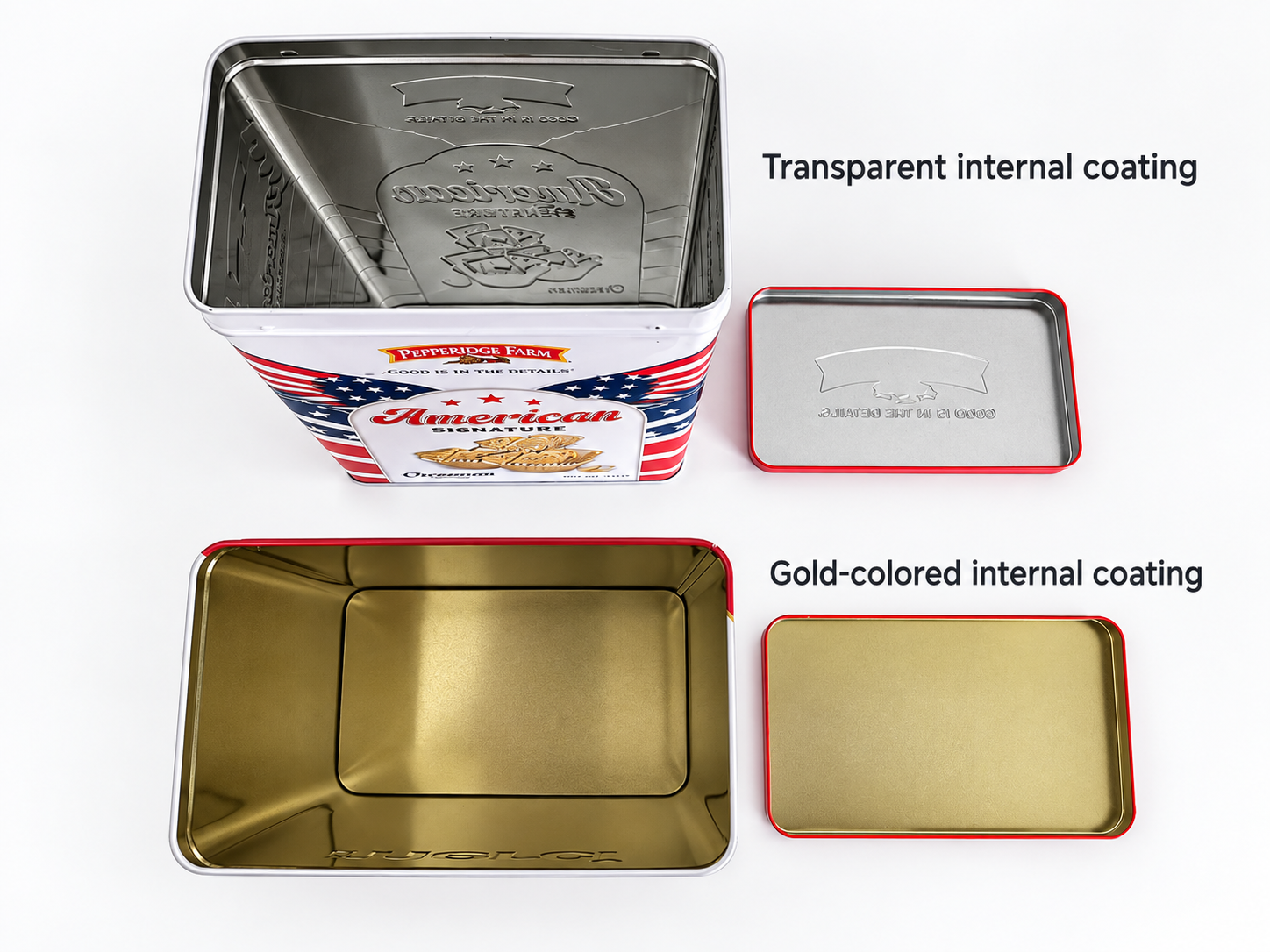
| Gold-colored internal coating | Protects the tinplate and creates a gold visual finish. | Coating specification and suitability for the intended food-contact conditions. |
| Transparent internal coating | Protects the tinplate while allowing the metal appearance to remain visible. | Coating specification and suitability for the intended food-contact conditions. |
| Supplier and batch information | Supports material identification and traceability. | Purchase records, lot references, supplier documents, and coating or ink batch records. |
Gold-colored and transparent internal coatings mainly differ in visible appearance. Both are internal coating processes used to protect the tinplate surface; they should not be presented as completely different safety grades without reference to their actual formulation and intended use.
3. Internal Coatings for Food Tin Boxes
The inside of a tin intended for direct food contact normally requires a protective internal coating. Common appearances include transparent, silver-looking, and gold-colored finishes. A silver appearance does not necessarily mean the metal is uncoated; a transparent coating can leave the underlying tinplate visible.
Applying the transparent or gold-colored internal coating is an important finishing operation before the printed sheet is cut and formed. For general-line tin projects, HYTINPACK typically uses a composite food-contact internal coating system selected according to the intended application.
The final coating choice should be confirmed according to the food type, contact duration, temperature, acidity, oil content, moisture, filling method, and destination market. One coating system cannot automatically be assumed to suit every food or every country.
4. Color Control and Pantone Matching
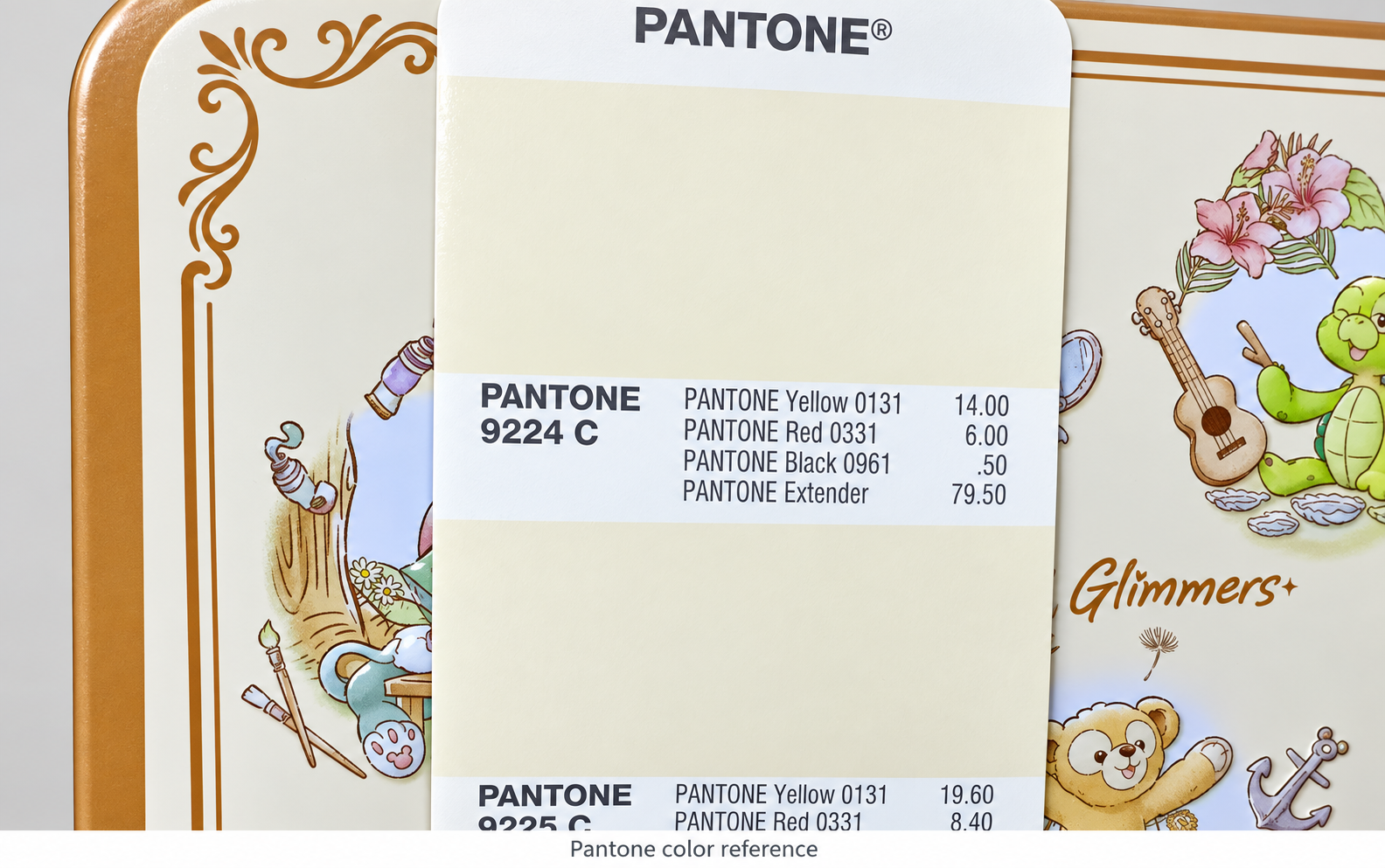
Pantone references, CMYK values, printed proofs, and an approved physical sample are important color-control references. Inspection should also cover artwork position, registration accuracy, color consistency, the white base, and the final varnish appearance.
Colors viewed on a screen can differ from colors printed on tinplate. The approved physical proof or agreed color sample should be the primary reference for production. Visible color can be influenced by the tinplate surface, white base coverage, ink density, varnish, forming, and lighting conditions.
5. Quality Control from Incoming Materials to Finished Products
Quality control follows the material and the formed components through the production route. Inspection points are selected according to the product structure, process risk, customer specification, and agreed sampling plan.
For a broader view of these manufacturing stages, see how custom tin boxes are made.
6. Incoming Material Inspection
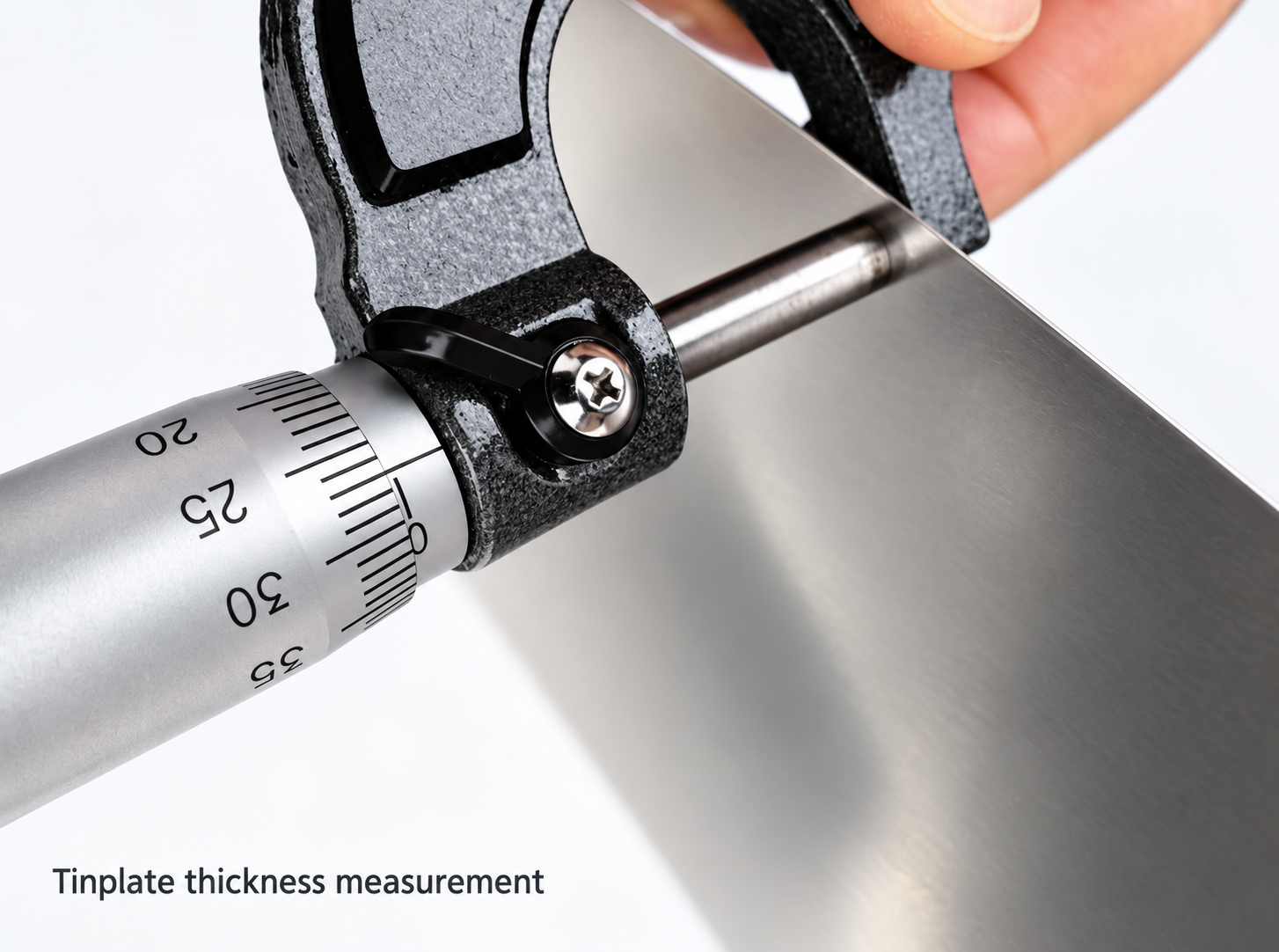
Incoming inspection can include tinplate thickness, hardness or temper, surface condition, tin coating information, sheet dimensions, material identification, supplier documents, and batch or lot information. Ink and coating batch records may also be retained for traceability.
The inspection scope should match the approved specification. A material name alone is not enough; thickness, temper, surface quality, and coating details can affect forming, appearance, and final use.
7. Printing Inspection
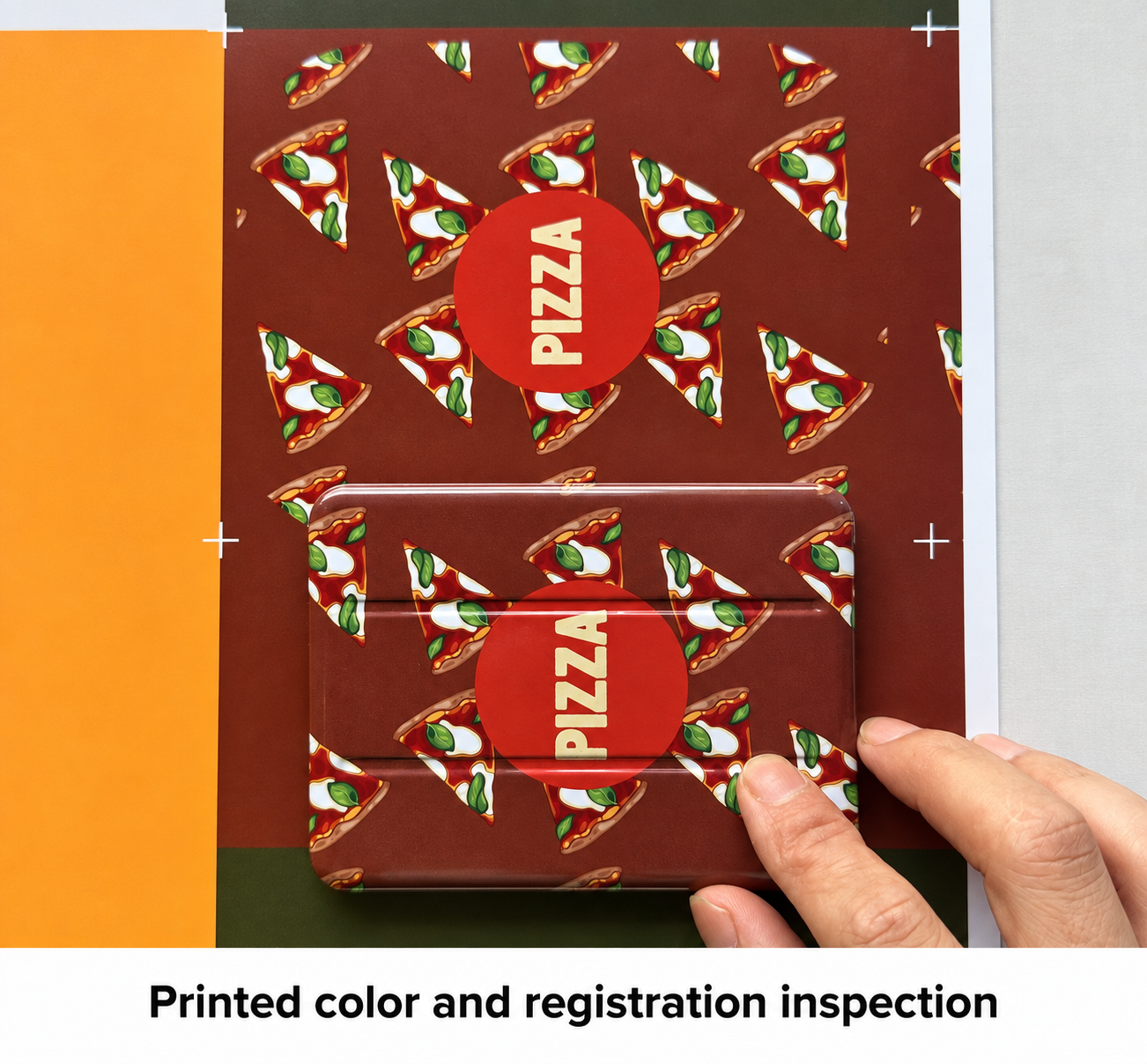
Printing inspection can cover artwork position, registration accuracy, color consistency, printing coverage, white base coverage, text and logo clarity, missing or blurred details, scratches, stains, varnish coverage, matte or glossy finish, and printing adhesion.
Checks should compare the printed tinplate and formed components with the approved proof, artwork, and agreed tolerances. Forming can change how artwork aligns around edges, seams, corners, and embossed areas, so both flat sheets and formed parts may need review.
8. Stamping and Forming Inspection
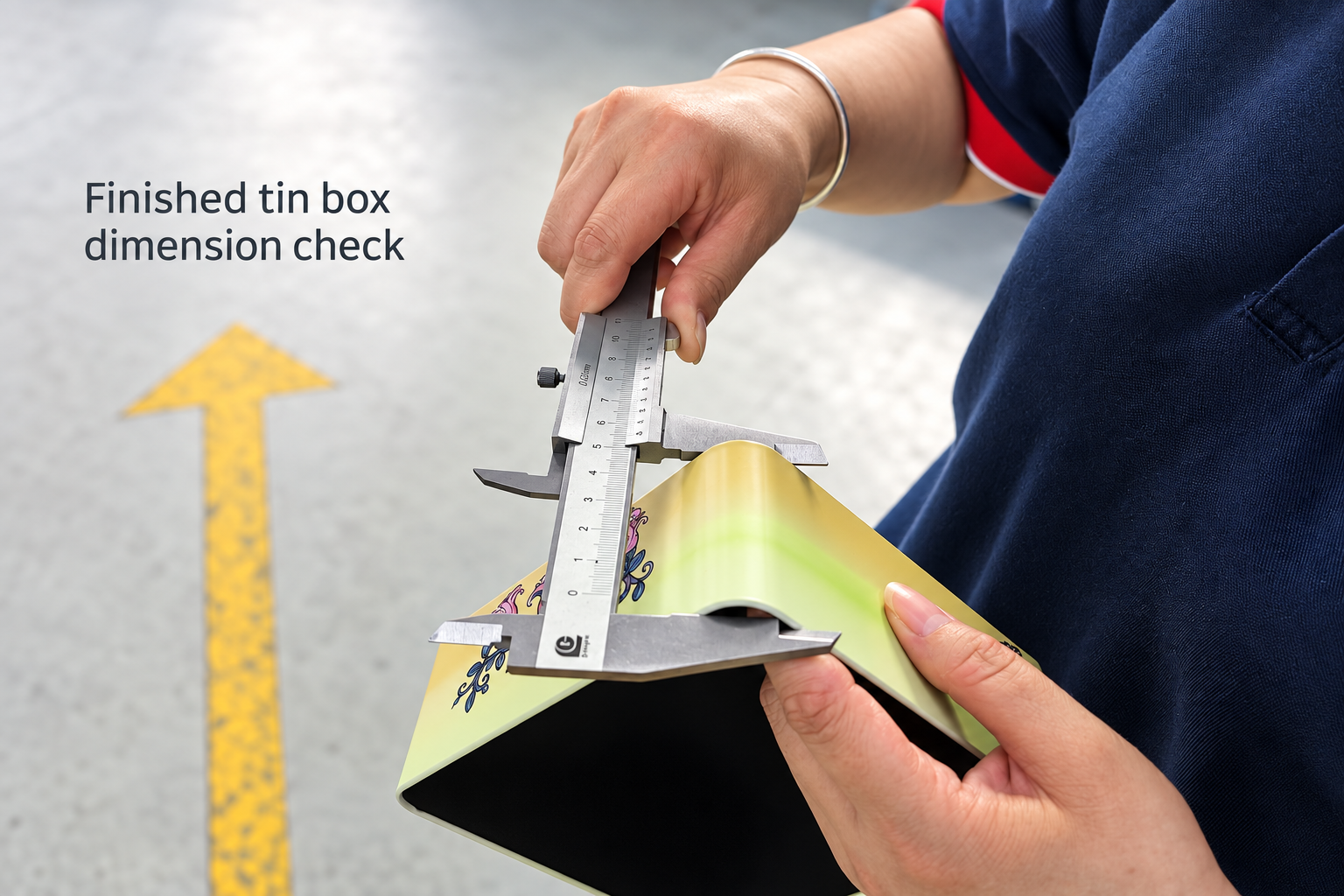
Dimensional and forming checks may include length, width, height, diameter or radius, corner shape, wall straightness, lid and body dimensions, curling or beading, dents, deformation, cracks, coating damage, sharp edges, and structural stability.
Measurements are compared with the approved drawing, specification, sample, and agreed production tolerance. A visually acceptable component can still cause assembly or closing problems if critical dimensions are outside tolerance.
9. Finished Product Inspection Tools
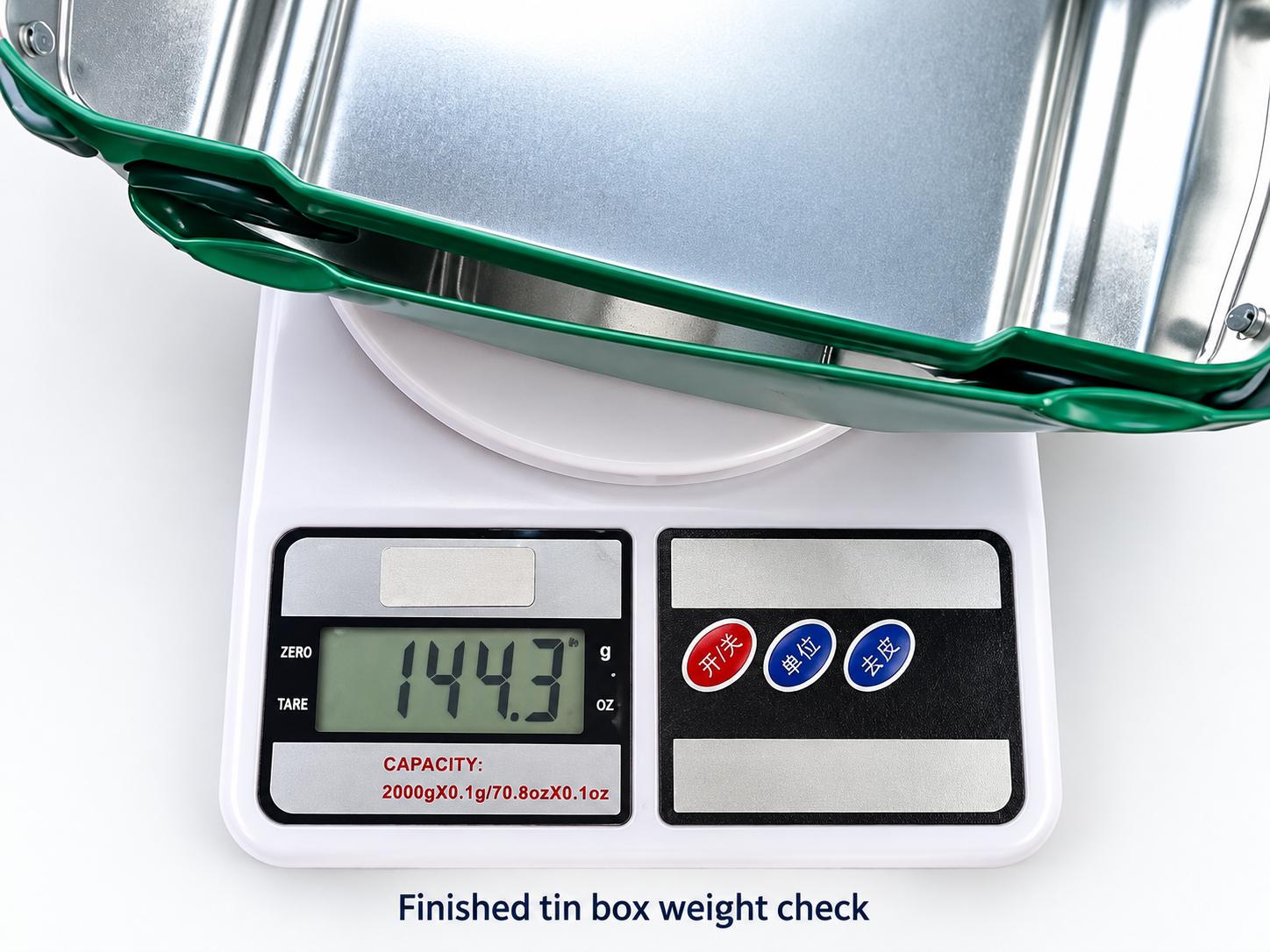
Depending on the product structure and customer requirements, inspection equipment may include vernier calipers, height gauges, micrometers, thickness gauges, color difference meters, cross-hatch adhesion test tools, torque or pull-force equipment, weighing scales, measuring fixtures, and visual inspection tables.
Not every project requires every tool. The measurement method, equipment, sample frequency, and acceptance tolerance should correspond to the relevant product characteristic and agreed inspection plan.
10. Lid, Body and Structural Inspection
Functional inspection may cover lid opening and closing, lid tightness, lid stability, body deformation, hinge and handle operation, sliding structures, click-clack structures, and child-resistant structures where applicable. Rolled edges and other exposed metal areas should be checked for sharp-edge risks.
Food-contact suitability does not automatically mean airtight or leakproof performance. Barrier, sealing, moisture, and leakage requirements must be specified and evaluated separately, often together with the primary inner packaging.
11. Common Defect Classification
Critical defects
- Sharp edges creating a safety risk
- Serious contamination
- Wrong material or coating
- Major structural failure
Major defects
- Lid cannot close correctly
- Severe deformation
- Serious color or printing error
- Incorrect dimensions
- Broken handle or hinge
- Significant coating damage
Minor defects
- Small surface marks
- Minor color variation within the agreed tolerance
- Small cosmetic scratches
- Minor printing imperfections
The final defect definitions, tolerances, and permitted quantities should be agreed before the order. The same visible condition can be classified differently depending on product use, retail positioning, approved samples, and customer requirements.
12. AQL Sampling and Final Inspection
HYTINPACK can use AQL sampling for suitable projects. AQL is not one fixed global quality standard, and an AQL value does not define the defects by itself. AQL 4.0 is a reference level used for some projects, but it is not automatically applied to every order.
Before production, the parties should confirm lot size, sample quantity, inspection level, critical, major, and minor defect definitions, and the corresponding acceptance and rejection numbers.
The overall quality plan may include first-piece approval, in-process inspection, random inspection, final inspection, and pre-shipment inspection. The appropriate combination depends on the manufacturing risk and customer requirements.
13. Preventing Dust, Oil and Foreign Materials
Production and packing areas should be kept orderly, and metal fragments, dust, oil, and packing residues should be removed. Approved and non-approved products should be separated, and finished tins should be checked before packing.
Suitable inner bags, dividers, liners, or protective packaging can reduce contamination and surface damage. Dirty surfaces should not be placed in direct contact with the inside of a tin. Cleaning and food-contact controls should be selected according to the intended use and agreed project requirements.
14. Testing Reports and Food-Contact Documents
Depending on the project and available supplier documentation, the factory may provide or help prepare a tinplate material report, internal coating report, ink or varnish report, MSDS or SDS, supplier compliance declaration, food-contact declaration, migration test report, heavy-metal or chemical test report, finished product inspection report, or third-party laboratory report.
Reference requirements may relate to EU food-contact rules, FDA-related requirements, LFGB, REACH, RoHS, EN 71, or other customer-specific and market-specific standards. The applicable standard must be confirmed for the actual product and destination; these references are not automatic certifications for every tin.
- A supplier material report is not the same as a complete test report for a specific finished tin box.
- Different artwork, inks, internal coatings, food uses, or destination markets may require new testing.
- Finished-product testing by SGS, Intertek, or another laboratory is normally paid for by the customer.
- HYTINPACK can help prepare representative samples and coordinate testing.
- Test samples should use the same tinplate, ink, internal coating, varnish, and production process intended for mass production whenever practical.
- Customers should confirm the required test standard before ordering.
- Special requirements must be agreed in advance and cannot be treated as an automatic guarantee of passing every standard.
15. Traceability and Handling of Quality Problems
Traceability can be supported through the purchase order number, production order number, production date, material batch, ink or coating batch, production line, inspection records, packing records, and shipment records.
If a quality issue is identified, a practical response process is:
- Stop or isolate affected products.
- Check the scope of the problem.
- Separate approved and non-approved products.
- Identify the possible cause.
- Rework when technically possible.
- Scrap non-conforming products when necessary.
- Reproduce the affected quantity if required.
- Record corrective action.
16. Third-Party Inspection and Customer Standards
Customers can arrange SGS, Intertek, or another third-party company to perform a pre-shipment inspection. Customers can also provide their own inspection standard before production.
The inspection company, date, AQL level, sample size, defect classification, packaging requirements, and acceptance criteria should be agreed in advance. Color, dimensions, light scratches, and other appearance details should be judged against the approved sample, drawing, specification, or mutually agreed tolerance.
For a complaint review, the customer should first provide clear product images, batch information, affected quantity, and a detailed problem description. If the parties disagree about the result, an independent laboratory or third-party inspection report can provide useful evidence.
17. What Buyers Should Confirm Before Ordering
- Product type
- Food or material to be packed
- Direct or indirect food contact
- Whether an inner bag or liner is used
- Tin dimensions
- Expected shelf life
- Storage temperature
- Acidity, oil content, and moisture
- Destination market
- Required internal coating
- Printing and varnish requirements
- Required test reports
- Required certificates or declarations
- Inspection standard
- AQL level
- Packing requirements
18. Frequently Asked Questions
Are your tin boxes food-grade?
Food-contact suitability is reviewed for the specific project. The tinplate, internal coating, inks, varnish, intended food, contact conditions, and destination-market requirements must be considered together.
Can the tin box directly contain food?
Direct contact may be possible when the complete material system and intended use have been confirmed. An inner bag, liner, tray, or sealed pouch is still recommended for many products and barrier requirements.
Are all tin boxes airtight?
No. Conventional general-line tins are not automatically airtight, liquid-tight, or sterile. Sealing and barrier performance require separate evaluation.
What foods can be packed in tin boxes?
Projects for tea, coffee, biscuits, chocolate, confectionery, powders, and similar foods can be evaluated. High-acid, high-moisture, high-oil, hot-fill, or long-contact applications require additional coating and testing review.
Can you provide food-contact documents?
Available documents depend on the material, coating, supplier, and project. HYTINPACK can review existing supplier reports and help coordinate project-specific documents or testing.
Does a material report certify the finished tin box?
No. A supplier report covers the stated material or coating and is not automatically a complete finished-product test report.
Can you arrange SGS or Intertek testing?
HYTINPACK can help prepare samples and coordinate third-party testing. The customer normally pays the laboratory and testing costs.
Can the customer arrange a pre-shipment inspection?
Yes. The inspection company, timing, sampling plan, defect definitions, and acceptance criteria should be confirmed before inspection.
Do you use AQL inspection?
AQL sampling can be used when agreed for the project. The level, sample size, defect categories, and acceptance numbers must be defined rather than assumed.
What should we provide for a food tin quotation?
Provide the food type, direct or indirect contact requirement, tin size and shape, quantity, artwork, expected shelf life, inner packaging, destination market, required documents, testing standard, and inspection requirements.
PROJECT REVIEW
Request a Custom Food Tin Packaging Quote
Share the information needed for a practical material, coating, quality, and testing review:
- Product to be packed
- Tin shape and dimensions
- Quantity
- Artwork or reference image
- Direct or indirect food-contact requirement
- Destination market
- Required documents or testing
- Packing and inspection requirements
For related planning information, explore the custom tin packaging resources or review how custom tin boxes are made.
Content Review
Written by the HYTINPACK Editorial Team
Technically reviewed by the HYTINPACK Production Team
Dongguan Huaiyang Metal Manufacture Co., Ltd.
This guide provides general manufacturing and sourcing information. It is not legal, food-safety, or regulatory certification advice. Final material suitability, testing, quality criteria, and market requirements must be confirmed for the specific project.
